

How Hypnotherapy Can Help You Quit Smoking and Vaping

Imagine breaking free from the grips of smoking and vaping by leveraging the deep power of your subconscious mind. Hypnotherapy provides a unique and science-backed method to target nicotine addiction at its roots. This proven approach offers hope, addressing both the psychological and physical ties to smoking and vaping. Whether you’ve tried quitting before or are considering it for the first time, hypnosis can help you achieve lasting change.
Table of Contents
-
-
- The Science Behind Hypnotherapy
- How Hypnosis Works
- How Hypnotherapy Rewires the Brain
- Why Hypnotherapy is Unique
- Understanding Habit vs. Addiction
- How Hypnotherapy Targets Addiction
- Breaking the Reward Cycle
- Proven Success Rates
- The Hypnotherapy Process
- Techniques to Support Quitting Smoking and Vaping
- Take the First Step Toward a Smoke-Free Life
-
The Science Behind Hypnotherapy
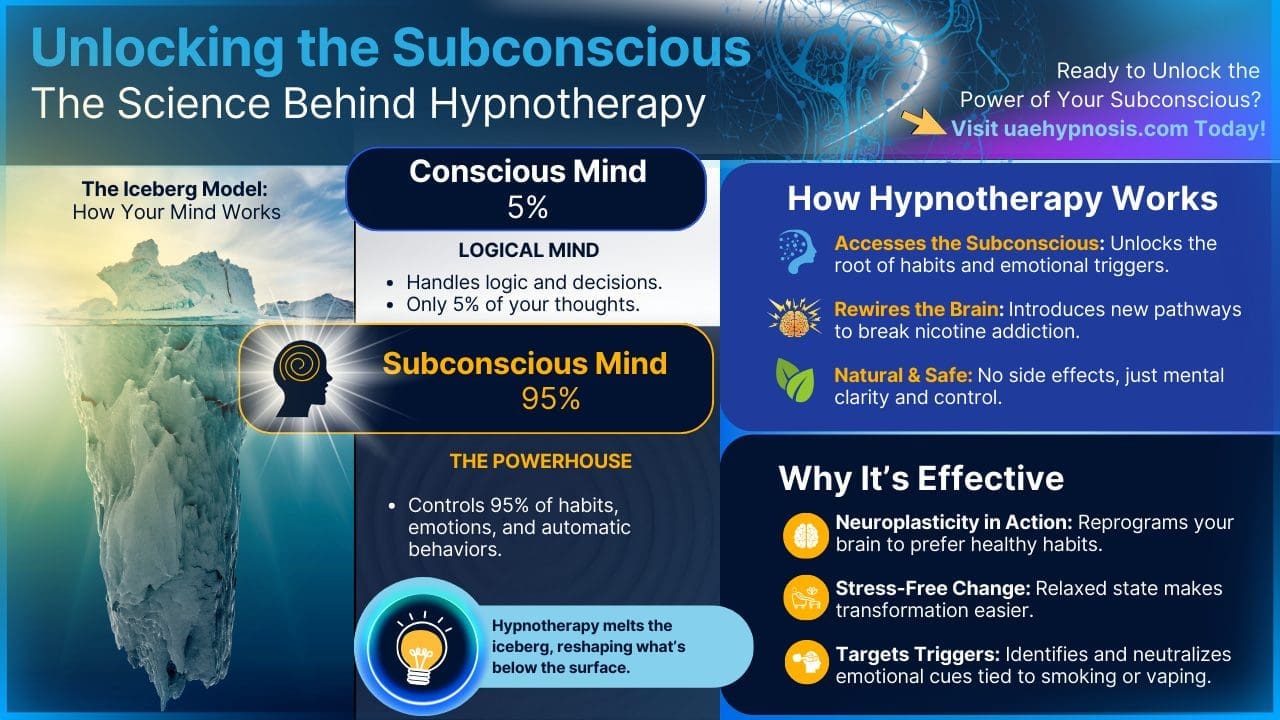
Hypnotherapy is a powerful method that works by accessing the subconscious mind—the part of your brain responsible for automatic habits and emotional responses. In a session, you enter a state of deep relaxation and heightened focus. This is not sleep or mind control, but a state where your conscious mind takes a backseat, allowing the subconscious to become more receptive to positive change.
How Hypnosis Works
The subconscious mind is like a vast storage system for habits, beliefs, and emotional associations. It operates silently, influencing most of your actions without conscious thought. Smoking and vaping often become deeply embedded in this part of the mind, tied to emotional triggers, daily routines, or even self-identity.
Hypnotherapy helps by guiding you into a heightened state of suggestibility where these deeply rooted patterns can be explored and modified.
A skilled hypnotherapist uses tools such as:
-
-
- Positive Suggestions
- Visualization Techniques
- Guided introspection
-
these tools help to “rewrite the script” in your subconscious mind.
How Hypnotherapy Rewires the Brain
-
-
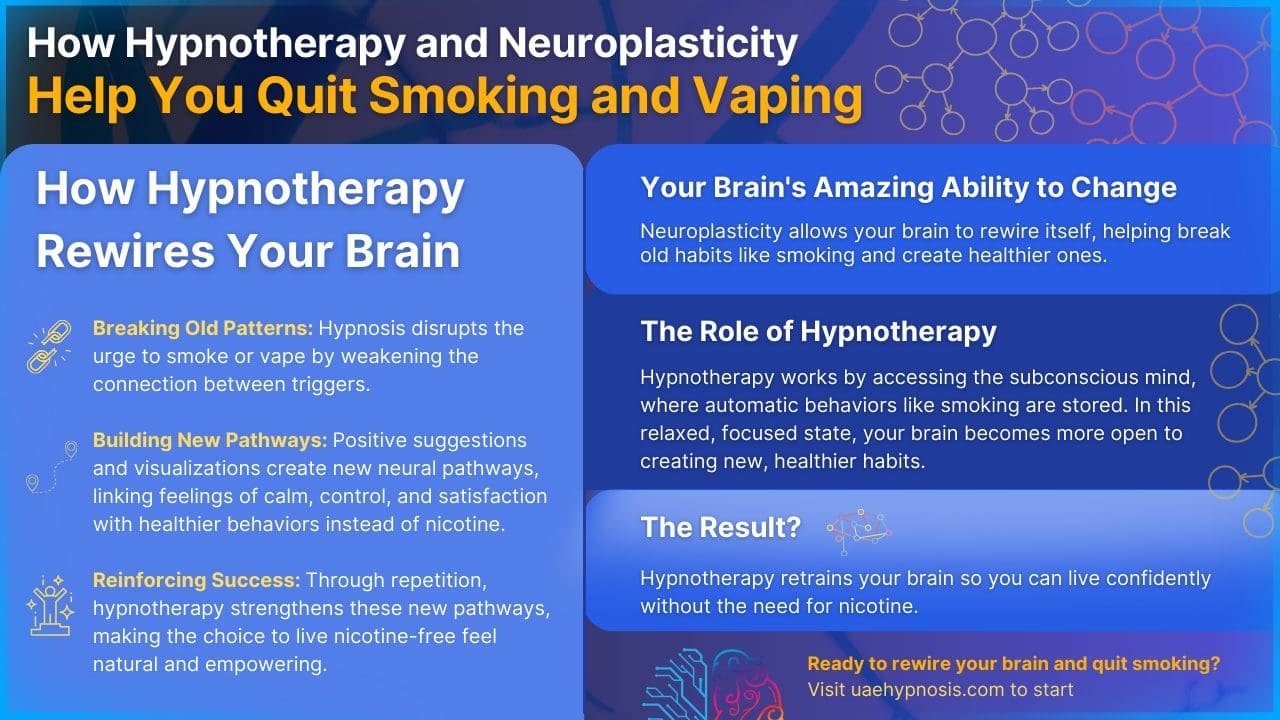
- Accessing the Subconscious Mind: The subconscious stores automatic behaviors, like reaching for a cigarette after meals or vaping during breaks. Hypnosis bypasses the critical, analytical part of the brain, creating an opportunity to introduce healthier patterns and remove old, negative associations.
- Activating Neuroplasticity: Hypnotherapy leverages neuroplasticity—the brain’s ability to form and strengthen new pathways. By repeatedly reinforcing positive behaviors in this state, the brain rewires itself, replacing nicotine-related habits with healthier alternatives.
- Lowering Stress Levels: Stress is a major driver of nicotine use. Hypnosis induces deep relaxation, reducing stress and anxiety naturally, which helps break the reliance on smoking or vaping as a coping mechanism.
-
Why Hypnotherapy is Unique
Hypnotherapy goes beyond the common route that most use to manage cravings and addiction such as nicotine replacement therapy (NRT) or medications.
Hypnotherapy goes straight to the source of the deeply rooted emotional and psychological layers driving the compulsion to smoke or vape.
These sources may stem from unresolved past experiences, emotional wounds, or ingrained beliefs that reinforce the behavior. By exploring these issues, understanding their origins, and reframing their impact, hypnotherapy provides a truly transformative approach to quitting.
Understanding Habit vs. Addiction
-
-
- A Habit is a behavior you repeat because it feels familiar or fits into a routine. Habits, while automatic, are more easily broken because they lack a deep emotional or psychological tie. For example, smoking after a meal might simply be a learned habit tied to a specific moment in your routine.
- An Addiction, however, goes much deeper. It creates a cycle of dependence, where the substance is used not just out of routine but to fulfill an emotional or psychological need. Addiction often brings temporary relief—such as calming stress or dulling discomfort—making it feel essential. The addictive cycle controls you because you feel you “need” the substance to function or feel balanced.
-
How Hypnotherapy Targets Addiction
Hypnotherapy uncovers what you gain from the addiction—such as stress relief, a sense of control, or escape—and replaces it with healthier, more empowering coping mechanisms.
-
-
- Investigates the Emotional Past
- Revealing Emotional Triggers: Hypnosis acts as a tool for introspection, helping individuals explore the moments in their lives when smoking or vaping first took hold. For some, it may have been a way to manage overwhelming stress, mask feelings of inadequacy, or cope with loneliness. Others may have grown up in an environment where smoking was modeled as a coping mechanism by parents or caregivers. Watching a mother or father light up during stressful moments or using cigarettes to “unwind” can create a subconscious association between nicotine and emotional relief. These early experiences often become deeply ingrained, influencing a person’s own reliance on smoking or vaping as they navigate life’s challenges.
- Understanding the Connections: By safely revisiting and reflecting on these emotional experiences, clients can see how their past has shaped their present relationship with nicotine. This understanding creates clarity about why they smoke or vape, helping them uncover hidden emotional drivers.
- Investigates the Emotional Past
-
- Reframes the Past for Lasting Change
- Seeing with New Perspective: Once emotional triggers and past experiences are understood, hypnotherapy reframes them. A traumatic or stressful memory associated with smoking might be softened and seen through a lens of empowerment, transforming it from a reason to smoke into a catalyst for positive change.
- Detaching Emotional Dependence: By separating nicotine use from its perceived emotional benefits, hypnotherapy frees clients from the idea that smoking or vaping is necessary to cope or feel relief.
- Reframes the Past for Lasting Change
-
- Breaks the Addiction’s Control
- Replacing Dependency with Choice: Addiction thrives on the illusion of control—making you believe you “can’t quit” or “need nicotine to feel better.” Hypnotherapy empowers you to take back control by dismantling this belief.
- Creating Healthier Alternatives: Hypnosis replaces the addiction’s hold with healthier substitutes, like exercise, reading, relaxation techniques or mindfulness, that fulfill the same emotional needs in a constructive way.
- Breaks the Addiction’s Control
-
- Targets Emotional Triggers and Conditioned Responses:Hypnotherapy works with the the mental and emotional conditioning that perpetuates addiction:
- Interrupting Automatic Responses: Smoking or vaping often becomes tied to specific activities, such as enjoying coffee, relaxing after work, or handling stressful moments. Hypnotherapy helps break these links by reprogramming how the mind associates these triggers with nicotine.
- Replacing Negative Cycles with Positive Ones: Hypnotherapy introduces new, empowering beliefs, such as “I feel calm and peaceful without smoking” or “I feel better without nicotine,” replacing old, self-limiting patterns.
- Targets Emotional Triggers and Conditioned Responses:Hypnotherapy works with the the mental and emotional conditioning that perpetuates addiction:
-
- Reinforces Positive Beliefs for Long-Term Success
- Strengthening Self-Belief: Hypnotherapy helps clients…
- Visualizing Success: By imagining themselves as non-smokers, feeling healthier, happier, and in control, clients create a mental blueprint that guides their real-world behavior.
- Reinforces Positive Beliefs for Long-Term Success
-
Try this visualization:
During a hypnotherapy session, a client is guided to close their eyes and imagine, sense and feel waking up in the morning as a non-smoker. They take a deep breath of fresh air, feeling their lungs expanding with ease, free from the heaviness of nicotine. As they go about their day, they picture themselves sipping their morning coffee without the urge to smoke. They feel proud, energized, and in control, confidently tackling challenges without relying on cigarettes.
The visualization continues as they see themselves enjoying time with family or friends, laughing and connecting without the interruption of a smoke break. They picture compliments from loved ones about how much healthier they look, reinforcing a sense of accomplishment. Each scene is vivid, engaging all their senses—tasting fresh air, feeling their body stronger and more vibrant, and hearing affirmations of their success.
By repeatedly visualizing this future self, the client’s subconscious mind begins to accept and align with this new identity, reinforcing their motivation and building a mental framework for a smoke-free life.
This immersive practice helps translate the imagined success into real-world actions, making the journey to quitting feel tangible and achievable.
Breaking the Reward Cycle
Nicotine addiction is reinforced by the brain’s reward system, which releases dopamine during smoking or vaping. To understand how hypnotherapy helps, you must first understand how the reward cycle works.
The Brain and Hypnotherapy
Nicotine addiction thrives on the brain’s reward system, which operates as a built-in reinforcement mechanism. Each time nicotine is consumed, it stimulates the release of dopamine—a neurotransmitter associated with pleasure, satisfaction, and reward. This creates a temporary “feel-good” sensation, which the brain quickly learns to associate with smoking or vaping. Over time, this cycle becomes automatic, deeply embedding nicotine as the go-to solution for stress relief, focus, or emotional escape.
Why the Reward Cycle is So Powerful
-
-
- Behavioral Triggers: The brain begins to link nicotine not only to pleasure but also to specific situations, like drinking coffee, socializing, or even taking a break at work. These cues become triggers, reinforcing the habit.
-
- Instant Gratification: Nicotine works almost instantly, giving users a quick dopamine surge. This immediate reward conditions the brain to seek out nicotine whenever discomfort, stress, or boredom arises.
- Tolerance and Dependency: Over time, the brain adapts to nicotine’s effects, requiring more frequent or larger doses to achieve the same dopamine boost. This escalates dependency and strengthens the reward loop, making quitting feel overwhelming.
-
How Hypnotherapy Breaks This Cycle
Hypnotherapy disrupts this deeply ingrained pattern by addressing both the psychological triggers and the brain’s conditioned responses. Here’s how it works:
-
-
- Rewriting Neural Associations: Hypnotherapy helps the brain unlink nicotine from pleasure by creating new, healthier associations:
- Imagining Alternatives: In a hypnotic state, clients are guided to visualize situations where they previously smoked or vaped but now respond with healthier behaviors, like taking deep breaths, sipping water, or going for a short walk.
- Positive Replacements: The subconscious is introduced to new sources of reward, such as the sense of accomplishment from exercising, the relaxation of meditation, or the connection felt in social activities without nicotine.
- Rewriting Neural Associations: Hypnotherapy helps the brain unlink nicotine from pleasure by creating new, healthier associations:
-
- Redefining Triggers: Triggers are reframed during hypnotherapy sessions to reduce their power:
- Trigger Awareness: Clients are guided to identify specific moments when they feel the urge to smoke or vape. They learn to recognize these as patterns, not necessities.
- Empowering Responses: Instead of reaching for nicotine, clients rehearse responding to triggers with empowering actions, such as grounding techniques, affirmations, or mindfulness exercises.
- Redefining Triggers: Triggers are reframed during hypnotherapy sessions to reduce their power:
-
- Retraining the Brain’s Reward System: Nicotine conditions the brain to prioritize short-term pleasure over long-term well-being. Hypnotherapy reorients this reward system by:
- Focusing on Long-Term Rewards: Clients visualize the long-term benefits of quitting, like improved health, increased energy, and financial savings. This helps the brain recognize these outcomes as greater rewards than the temporary high of nicotine.
- Reinforcing Self-Control: Suggestions during hypnosis strengthen the belief that the individual has the power to resist cravings, which boosts confidence and shifts the focus away from nicotine as a source of satisfaction.
- Retraining the Brain’s Reward System: Nicotine conditions the brain to prioritize short-term pleasure over long-term well-being. Hypnotherapy reorients this reward system by:
-
The Science of How Hypnosis Affects the Brain
-
-
- Neuroplasticity in Action: Hypnosis taps into the brain’s neuroplasticity—the ability to form new neural pathways. By repeatedly practicing healthier responses in a suggestible state, the brain rewires itself to prefer these new behaviors over old habits.
-
- Calming the Fight-or-Flight Response: Nicotine often soothes stress by dampening the brain’s fight-or-flight response. Hypnosis provides alternative relaxation techniques, helping clients achieve calmness naturally without nicotine.
-
Reducing Dependency
Breaking the reward cycle is about about filling the void of nicotine with meaningful, fulfilling alternatives:
-
-
- Shifting the Brain’s Focus: Hypnotherapy gradually shifts the brain’s reliance on nicotine by encouraging the subconscious to prioritize intrinsic rewards, like feeling stronger, breathing more easily, or enjoying moments without interruption.
-
- Creating Resilience: Clients learn to manage cravings by visualizing success and embracing their ability to handle stress or discomfort without nicotine.
-
Proven Success Rates: Why Hypnosis Works
Scientific studies consistently highlight hypnotherapy as a highly effective method for smoking cessation. Below are some key findings that illustrate its benefits:
-
-
- Holistic Approach: Hypnotherapy addresses both the emotional and physical aspects of addiction, making it more comprehensive than traditional methods.
-
- Reduced Relapse Risk: By tackling subconscious triggers, hypnosis significantly lowers the likelihood of relapse.
-
- Higher Quit Rates: A randomized controlled trial found that 50% of patients treated with hypnotherapy were smoke-free at six months, compared to only 15.8% using nicotine replacement therapy (NRT).
-
These results are further supported by a study conducted on 67 smoking patients hospitalized with cardiopulmonary diagnoses. The study compared the effectiveness of hypnotherapy, nicotine replacement therapy (NRT), and a combination of both, as well as quitting “cold turkey.” Here’s a detailed breakdown of the findings:
Case Study: Hypnotherapy: An Effective Method for Smoking Cessation
Source: DOI:https://doi.org/10.1378/chest.132.4_MeetingAbstracts.527a
Study Overview:
-
-
- Participants: 67 smoking patients hospitalized with cardiopulmonary diagnoses.
-
- Groups:
- Hypnotherapy (n=14)
- Nicotine Replacement Therapy (NRT) (n=19)
- Combination of NRT and Hypnotherapy (n=18)
- Control group quitting “cold turkey” (n=16)
- Intervention: Intensive counseling, self-help brochures, follow-up calls, and, for some, a free hypnotherapy session and self-hypnosis audios.
- Groups:
-
- Results:
- Quit Rates at 26 Weeks:
- Hypnotherapy: 50%
- NRT and Hypnotherapy: 50%
- Control (Cold Turkey): 25%
- NRT alone: 15.78%
- Diagnosis Impact:
- Cardiac patients: 45.5% quit rate
- Pulmonary patients: 15.63% quit rate
- Quit Rates at 26 Weeks:
- Results:
-
- Key Insights:
- Higher Efficacy: Hypnotherapy and the combination of NRT and hypnotherapy resulted in higher quit rates compared to NRT alone or quitting cold turkey.
- Emotional Impact: Patients with cardiac diagnoses were more likely to quit, possibly due to the perceived immediate threat to their health.
- Key Insights:
-
- Expert Opinions:
- Dr. Faysal Hasan: “Hypnotherapy appears to be quite effective and a good modality to incorporate into a smoking cessation program after hospital discharge.”
- Dr. Alvin V. Thomas: “The results confirm that using a multimodality approach to smoking cessation is optimal for success.”
- Expert Opinions:
-
This study shows that hypnotherapy is a highly effective tool for smoking cessation, especially when used in conjunction with other methods like NRT.
These findings were confirmed in the full randomized controlled trial: Hasan FM, Zagarins SE, Pischke KM, et al. “Hypnotherapy is more effective than nicotine replacement therapy for smoking cessation: results of a randomized controlled trial.” Complementary Therapies in Medicine. 2014;22(1):1-8. The completed study found hypnotherapy outperformed nicotine replacement therapy in helping hospitalized patients quit smoking.
The Hypnotherapy Process
-
-
- Initial Consultation and Goal Setting
It’s necessary to begin with an in-depth consultation to understand your smoking or vaping habits, triggers, and motivations. This consultation helps tailor your hypnotherapy sessions to your unique needs. - Hypnotherapy Sessions
Induction Into a Relaxed State Through progressive relaxation and guided imagery, the hypnotherapist helps you enter a calm, focused state. In this state, your subconscious mind becomes receptive to change.
- Initial Consultation and Goal Setting
-
Addressing Past Experiences and Beliefs
Hypnotherapy works by bringing to the surface past experiences and beliefs that contribute to the addiction. For example, a person might have started smoking as a coping mechanism for stress or anxiety during a challenging period in their life. Through hypnosis, these experiences can be revisited and reinterpreted in a way that removes their power over the individual. This process involves:
-
-
- Regression Therapy: Taking the client back to the time when the habit began to understand the context and emotions involved.
-
- Reframing: Changing the perception of those past experiences to reduce their emotional impact. This helps in breaking the emotional connection to nicotine.
-
- Creating New Associations: Developing new, positive associations that replace the old, negative ones linked to smoking and vaping.
-
Emotional Healing
If emotional triggers like stress or trauma fuel your nicotine use, hypnotherapy can help you process and release these feelings, reducing the need to rely on smoking or vaping as a coping mechanism.
Behavioral Reconditioning
Hypnotherapy instills new habits and responses to triggers. These habits are designed to replace the emotional and physical dependency on nicotine with constructive and empowering behaviors. Examples include:
-
-
- Deep Breathing Exercises: Replacing the act of inhaling nicotine with slow, controlled breathing helps reduce stress and mimic the calming sensation smokers or vapers often associate with their habit.
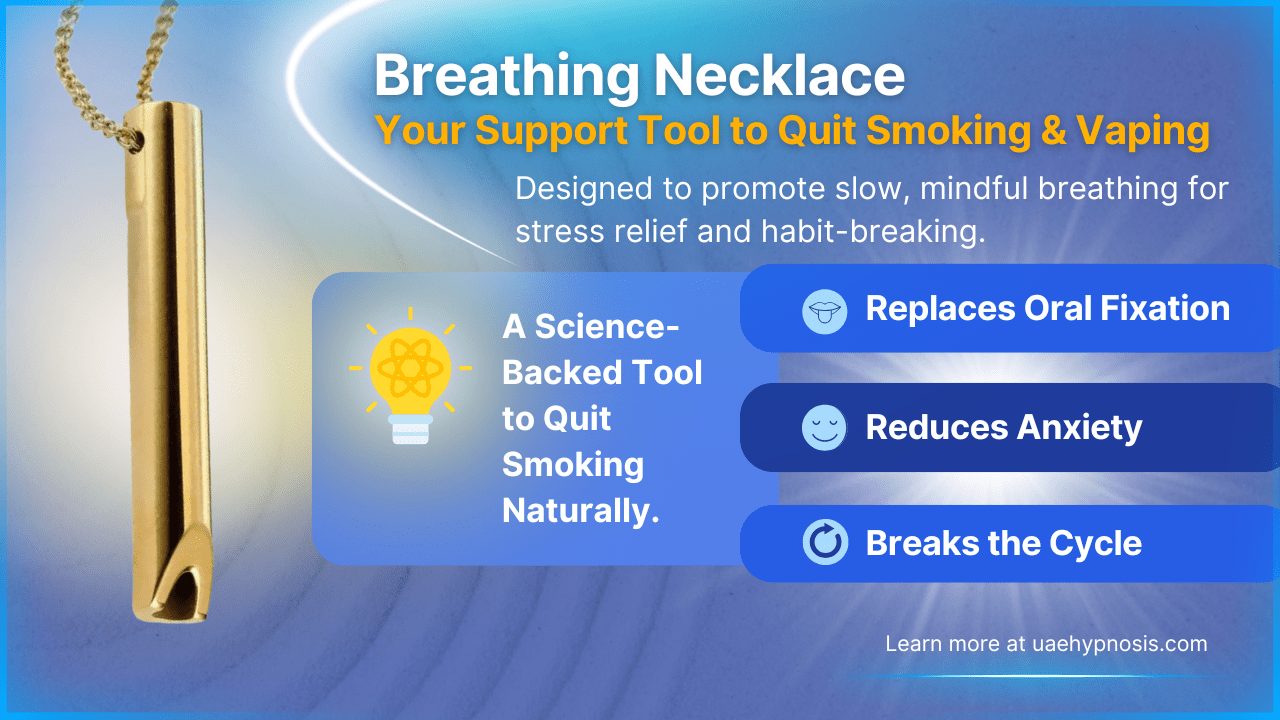
- Try this now: Use a breathing necklace to:
- Replace Oral Fixation: Satisfy the need for a physical habit without nicotine.
- Reduces Anxiety: Be calm through slow, mindful breathing.
- Break the Cycle: Disrupt the automatic urge to vape and smoke. Create healthier habits.
- Try this now: Use a breathing necklace to:
- Deep Breathing Exercises: Replacing the act of inhaling nicotine with slow, controlled breathing helps reduce stress and mimic the calming sensation smokers or vapers often associate with their habit.
-
- Mindfulness Practices: Techniques such as meditation or grounding exercises teach individuals to remain present and manage cravings without turning to nicotine.
-
- Physical Activity: Incorporating activities like walking, yoga, or light exercise can serve as a healthy distraction and help release endorphins, naturally reducing stress and boosting mood.
-
What to Expect in a Session
During the Session: You are always 100% in control!
-
-
- Induction: The session begins with the hypnotherapist guiding you into a relaxed and focused state. This induction phase involves techniques such as deep breathing, progressive relaxation, and guided imagery.
- Regression Therapy: If necessary, the hypnotherapist may use regression techniques to explore and resolve past experiences contributing to your nicotine addiction. By identifying and reframing these past experiences, the therapist helps to alleviate the emotional triggers that drive the addiction, leading to physiological, psychological, and behavioral changes.
- Therapeutic Suggestions: Once in the hypnotic state, the hypnotherapist provides positive suggestions and affirmations aimed at changing your smoking and vaping habits.
- Visualization: You may be guided to use all your senses to visualize yourself as a non-smoker or non-vaper. Imagine the taste of fresh, clean air, the smell of nature, the sight of yourself engaging in healthy activities, the sound of your clear and strong voice, and the feel of your vibrant, healthy body enjoying a life free from nicotine.
-
After the Session
-
-
- Gradual Awakening: The hypnotherapist will gently guide you out of the hypnotic state, leaving you feeling relaxed, refreshed, and connected.
- Immediate Benefits: Many clients report an immediate reduction in cravings and a stronger commitment to quitting.
- Continued Practice & Self-Hypnosis Tools: You may be given self-hypnosis techniques or recordings to reinforce the session’s benefits.
-
Follow-Up Sessions
Follow-up sessions are crucial for reinforcing the changes made during the initial hypnosis session. These sessions provide continued support and help address any challenges that arise. They can also include:
-
-
- Progress Review: Assessing how well the initial session’s suggestions have been integrated and addressing any remaining issues.
- Additional Techniques: Introducing new hypnosis techniques or coping strategies as needed.
- Ongoing Motivation: Reinforcing your commitment to staying smoke-free and celebrating your successes.
-
Techniques to Support Quitting Smoking and Vaping
-
-
- Deep Breathing with Tools: Using a breathing necklace can replace the oral fixation of vaping and serve as a calming tool for anxiety.
- Physical Disruption of Habits: Switching to your non-dominant hand for habitual tasks disrupts automatic behaviors, making you more mindful.
- Daily Visualization: Spend 5 minutes each morning visualizing yourself as a non-smoker, feeling vibrant, strong, and in control.
- Self-Hypnosis: By reinforcing new, healthier behaviors during hypnosis, you can develop alternative coping mechanisms and habits.
-
Try Self-Hypnosis to Stop Smoking Now:
Take the First Step Toward a Smoke-Free Life
Quitting smoking and vaping can feel overwhelming, but with hypnotherapy, you don’t have to do it alone. This powerful, evidence-based approach targets the root causes of addiction, empowering you to reclaim control and live a healthier, happier life.
Why Choose Hypnotherapy?
- Safe and Natural: No medications or side effects.
- Comprehensive: Addresses both psychological and physical aspects of addiction.
- Long-Lasting Results: Reprograms the subconscious mind for sustained success.
Your New Life Starts Here
Quitting smoking and vaping is an achievable goal with the right support and approach. Hypnosis offers a powerful, natural solution that addresses the root causes of nicotine addiction and promotes long-lasting, positive change. By reprogramming the subconscious mind and reinforcing healthy habits, hypnotherapy can help you quit smoking and vaping easily and effectively.
If you’re ready to take control of your health and quit smoking or vaping, consider hypnotherapy. With the right guidance and commitment, you can achieve a nicotine-free life and enjoy the numerous benefits of improved health and well-being.
